
A Memorandum Concerning Homosexuality and Candidates for Admission to Seminary
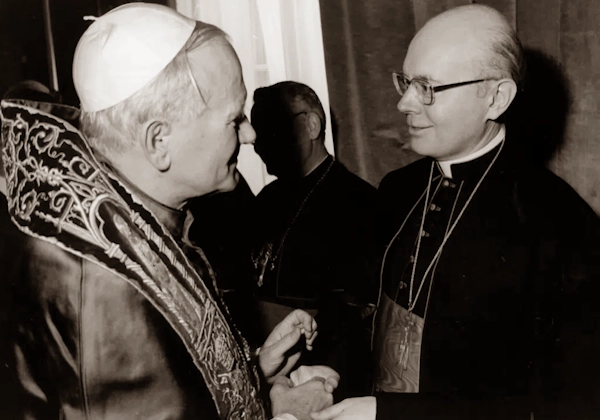
For the first time ever, we are publishing a memorandum sent by the Sacred Congregation for Catholic Education to Catholic bishops on July 9, 1985, while John Paul II governed the Church. It was signed by Cardinal William Wakefield Baum (1926–2015) and long-time undersecretary of the Congregation Francesco Marchisano (1929–2014).
SACRA CONGREGATIO PRO INSTITUTIONE CATHOLICA
[Sacred Congregation for Catholic Education]
Rome, 9th. July, 1985
PROT. N. 65/85
(Hic numerus in responsione referatur)
[This number should be mentioned in the response]
A Memorandum to Bishops seeking advice in matters concerning homosexuality and candidates for admission to Seminary
Candidates for the priesthood must satisfy a number of criteria of suitability, and it is important that all of these criteria be given proper, serious consideration. Amongst the sexual criteria, one considers the virtue of chastity as required by the Gospel, and the requirements of the particular call to celibacy. A candidate who is heterosexually active is not acceptable. A candidate who is given to ‘dating’, albeit chastely, is not acceptable. A candidate who is homosexually active or who leads a homosexual lifestyle (whether he is homosexual or not) is not acceptable. A high standard of chastity and integration of the personality is required before admission to seminary, such that latent or repressed homosexuality is also a counter-indication requiring that the candidate not be accepted – it would not be fair to the individual nor to the seminary community.
When a candidate who has a past history of unacceptable behaviour presents himself for admission to seminary further considerations enter in: has he since sustained a high standard of virtue over a substantial period of time? Is there any danger of scandal, to the Church or to the wider community in accepting him as a candidate? Given the particular nature of seminary life and formation and the stresses involved in the exercise of the ministry of priest, will he be able to maintain and grow in the standards of virtue he has already attained?
We feel that the distinction that has been made in the past between homosexual practice and orientation seems to us to have become blurred, with ‘orientation’ now allowing of the embrace of an unacceptable ‘commitment’ to or support of homosexual practices or lifestyles. We prefer to distinguish between practice, orientation and temptation, the first two being counter-indications of acceptability. Temptations may involve or depend on orientations, but we prefer to use the word temptation when the behavioural impulse, inclination or appetite does not involve orientation of the kind described above. People have to face many and diverse temptations in life, and the mark of a Christian is in bearing them and resisting them, with the grace of God, after the manner of Our Lord in the wilderness.
The selection of candidates for admission to seminary and the recommendation of their progress to Holy Orders are heavy responsibilities which immediately bear on the good of the candidates individually, the reputation of the clergy, and the spiritual health of the Church.
[Signed by]
William card. Baum, [Prefect]
Francesco Marchisano, Undersecretary