Virgin Most Prudent – Bishop Perić’s book on Medjugorje Published in English
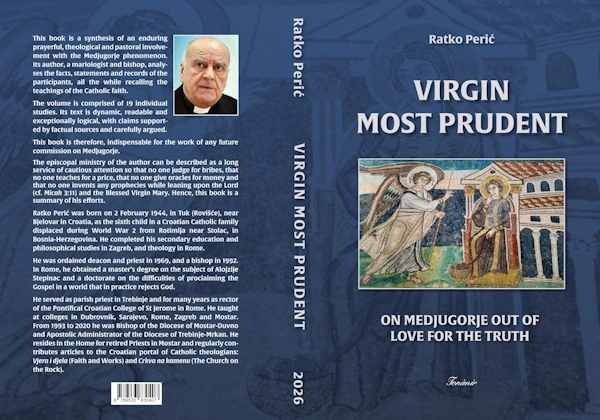
Tonimir Publishing House has published a book by Bishop Emeritus Ratko Perić: Virgin Most Prudent: On Medjugorje Out of Love for the Truth (August 2026, 311 pages).
This is an English translation of his book published in Croatian in September 2024, Djevice premudra: O Međugorju iz ljubavi prema istini.
The book can be ordered through Amazon.
The book, translated into English by Mario Glibić and Archbishop Petar Antun Rajič, is the fruit of a long-term prayerful, theological, and pastoral engagement with the Medjugorje phenomenon. Its author, a mariologist and bishop, analyses the facts, statements and records of the participants, all the while recalling the teachings of the Catholic faith.
The episcopal ministry of the author can be described as a long service of cautious attention so that no one judge for bribes, that no one teaches for a price, that no one give oracles for money and that no one invents any prophecies while leaning upon the Lord (cf. Micah 3:11) and the Blessed Virgin Mary. Hence, this book is a summary of his efforts.
Msgr. Perić was born on 2 February 1944, in Tuk (Rovišće), near Bjelovar in Croatia, as the sixth child in a Croatian Catholic family displaced during World War 2 from Rotimlja near Stolac, in Bosnia-Herzegovina. He completed his secondary education and philosophical studies in Zagreb, and theology in Rome.
He was ordained deacon and priest in 1969, and a bishop in 1992. He obtained a master’s degree on the subject of Aloysius Stepinac and a doctorate on the difficulties of proclaiming the Gospel in a world that in practice rejects God.
He served as parish priest in Trebinje and for many years as rector of the Pontifical Croatian College of St Jerome in Rome. He taught at colleges in Dubrovnik, Sarajevo, Rome, Zagreb and Mostar. From 1993 to 2020 he was Bishop of the Diocese of Mostar-Duvno and Apostolic Administrator of the Diocese of Trebinje-Mrkan. He resides in the Home for retired Priests in Mostar and regularly contributes articles to the Croatian portal of Catholic theologians: Vjera i djela (Faith and Works) and Crkva na kamenu (The Church on the Rock).
The text of the book is dynamic, readable and exceptionally logical, with claims supported by factual sources and carefully argued.
This book is therefore, indispensable for the work of any future commission on Medjugorje.
The volume is comprised of 19 individual studies (pp. 11–290), notes on their origin (pp. 291–292), a bibliography (pp. 293–300), forewords by two international experts (pp. 7–9), reviews by two bishops (pp. 301–303), and an index of names (pp. 305–311).
The titles of the chapters are: An Explanation of the Title; Description of the Cover Image; One Cannot Do Anything against the Truth, but Only for the Truth; The Canonical and General Status of the Parish of Medjugorje (1892–1982); The “Apparitions” in Medjugorje and the Church Hierarchy 1982–1991; The Holy See Commission on Medjugorje 2010–2014; Are the Prayers of the Faithful Proof of “the Madonna’s Apparitions”? ; Medjugorje Paradoxes; The Medjugorje Phenomenon; The False Paths of Medjugorje; Fr Tomislav Vlašić – Spiritual Director of the Medjugorje “Visionaries”; Ambiguous Games regarding the “Great Sign”; The Spiritual Vocations of the Medjugorje “seers”; The “Apparitions” of the First Seven Days in Medjugorje; The Spiritual Director Fr Slavko Barbarić; Make-believe Tales regarding the Madonna’s Birthday; Touching the “Madonna’s” Dress and Veil; Preternatural Influences in Medjugorje; General Conclusion.
Recommendations for reading the book
Rev. Manfred Hauke
Professor of Dogmatic Theology at the Faculty of Theology in Lugano, Switzerland
Bishop Ratko Perić, during his tenure as the local ordinary of the Diocese of Mostar-Duvno (1993–2020), dealt extensively with the alleged Marian apparitions that began 45 years ago (on June 24, 1981) in Medjugorje. Bishop Perić is undoubtedly one of the foremost experts on the phenomenon and has published important statements on the subject. These are presented in revised form in this volume.
The volume also contains additional texts that have not yet been made available to the public. These include, in particular, critical remarks on the work of the Pontifical Commission from 2010 to 2014, as well as observations on the supernatural influences in Medjugorje.
In these texts, one can easily see his devoted pastoral concern for the flock entrusted to him, combined with theological clarity and necessary discernment required in this context. What is important is the willingness to ground pastoral care in Medjugorje in the truth that points to the problems tied to the alleged Marian apparitions.
This thoroughly documented work should be required reading for all those who deal with the Medjugorje phenomenon from a theological and pastoral perspective.
Marco Corvaglia
High school teacher in Casarano (Apulia, Italy) and researcher on religious phenomena interpreted as miraculous, from a historical perspective
In 2009, Pope Benedict XVI, made the commendable decision to entrust the Congregation (now the Dicastery) for the Doctrine of the Faith with the task of forming a commission of inquiry into Medjugorje, however, the results of this project have proven extremely disappointing.
In fact, the proceedings of the commission (2010–2014) chaired by Cardinal Camillo Ruini (theoretically confidential but made public by two well-known Catholic journalists) and the Note About the Spiritual Experience Connected with Medjugorje, published on September 19th, 2024, by the Dicastery for the Doctrine of the Faith, are riddled with factual, historical, documentary, and logical errors and have led the Holy See to adopt a contradictory and unclear position. So much so that, depending on one’s point of view, some interpret it as essentially a promotion of Medjugorje and others as essentially a rejection.
This current volume by Msgr. Perić, provides now an English translation of a previous edition published in Croatian, which is both useful and necessary, even more so than what might have been perceived when the author published the original version in mid-2024, shortly before the Dicastery for the Doctrine of the Faith issued the aforementioned Note (to which, therefore, no reference will be found in the text).
The work is solidly and thoroughly grounded in the facts, drawing abundantly from primary sources that shed light, in particular on the first decade of the phenomenon, which have been neglected both by apologetic essays and by the Pontifical Commission of Inquiry.
Msgr. Perić’s contribution to the analytical and informed study of the origins of Medjugorje is very valuable, first-rate, and fundamental.
In fact, a tree is recognized not only by its fruits, but also by its roots.
Mario Glibić
Member of the Liturgical Council of the Bishops’ Conference of Bosnia-Herzegovina, Sarajevo
This book, Virgin Most Prudent, by Bishop Ratko Perić, bishop emeritus of the Dioceses of Mostar-Duvno and Trebinje-Mrkan can be added to the short list of critical works on the Medjugorje phenomenon. The work is written in a scholarly yet clearly comprehensible style, that offers profound insights into the phenomenon from an ecclesiastical authority who was personally and directly involved in observing and assessing all the events.
The book provides very clear, logical, consistent and well-substantiated answers to numerous questions arising from the Medjugorje phenomenon. The author presents the historical context, offers a theological analysis of the phenomenon, and demonstrates an exceptional ability to notice, connect and interpret details drawn from the numerous sources he has used, a considerable number of which are presented to the public for the first time. In all of this, he remains faithful to Catholic dogma and the Magisterium of the Church as it has been taught and professed for centuries. The various chapters radiate continuity and tradition, not rupture and novelty.
The work represents a prudent and rational approach to the emotivism that has affected many Catholics, that is, the understanding according to which moral positions are expressions of subjective emotions rather than objective values. Do those who “believe in Medjugorje” rely on their feelings or on objective theological criteria and the reasoning of the Church? Are feelings more important than truth, and is the pastoral dimension more important than the foundation on which it is built?
The subject matter of the book and the author’s motive are summed up by its subtitle, “On Medjugorje out of love for the truth”. And truth is not a beautiful ornament but a foundation, as stated in 2017, by the Prefect of the Congregation for the Doctrine of the Faith, Cardinal Müller: “What has been happening in Medjugorje for so many years and what has created a pastoral phenomenon must not rest on false foundations. We cannot separate the pastoral question from the question of the truthfulness of the apparitions.”
For all who wish to deepen their knowledge of the events in Medjugorje and the associated phenomenon, this book will serve as an excellent source of reliable information.
Danijel Vidović
Political scientist, layman, husband and father from Mostar
The author constantly adheres to the time-tested principle that truth must be consistent from all points of view, whereas falsehood is recognizable by any single flaw. For this reason, he vividly and straightforwardly demonstrates the untenability of the claims made by the key creators of the Medjugorje myth.
Bishop Perić approaches the handling of the phenomenon in a systematic and analytical manner, unmasking an entire swath of half-truths and untrue testimonies and illusions, which from 24 June 1981 onward, have accompanied this complex construct whose end is still nowhere in sight. Even the number of “apparitions” and “messages” have become exhausting both to follow and to count. The analysis shows that, in the end, the experts of the Ruini Commission did not even know the exact number of days or the apparitions on which they expressed a positive opinion.
In discerning the fruits of the phenomenon, the author insists on sound piety as opposed to spiritual abuses, founded on the manipulation of human emotions.
In seeking an answer to the question whether the Blessed Virgin Mary appeared in Medjugorje, his conclusions are simple and clear, and his argumentation firm and undeniable. He applies two criteria: firstly, has the Catholic Church always taught this? And secondly, does such belief express reasonable obedience (obsequium rationabile) to God?
For those who wish to look truth in the eye, the work is a valuable synthesis on the people and events, but also a reminder of how difficult it is to be, and to persevere, on the path of truth. And ultimately — how this is the only path worth pursuing.
The questions that remain after reading the book are directed towards the banks of the Tiber and read as follows: is truth still considered the fundamental criterion in the Catholic faith and pastoral ministry? Has it been pushed to the periphery of recent pastoral practice in this parish of Herzegovina under a foreign protectorate, and for what reason? Why then go on pilgrimage to a place of prayer that is not a shrine and that is not recommended as such?
Msgr. Martin Vidović
Titular Archbishop of Nin and Apostolic Nuncio
The book “Virgin Most Prudent” is entirely focused on the facts relating to the alleged apparitions of the Blessed Virgin Mary, starting from 24 June 1981 to the present day, in Medjugorje, in the Parish of St. James the Apostle, located in Brotnjo, a region of western Herzegovina, which is an integral part of the local Church of Mostar-Duvno. In presenting the facts and a wealth of data from first-rate sources, it is a unique testimony to the truth about Medjugorje. The facts and data presented in the book are unknown to the wider public and to this day have been obscured by propaganda that has concealed the contradictions and instead highlighted personal opinions and interpretations that seek to stifle any doubts on the credibility and reliability of the story of the apparitions.
In offering unique commentary on the events, the book encourages serious reflection on everything that has been happening in Medjugorje and that associated with it for more than four decades. Since it is based upon a critical approach to the facts in the search of the truth, it helps in discerning the reality of the events on which the Medjugorje rests upon, and in distinguishing between those speaking the truth and those who skirt it, as well as all the claims about Medjugorje, to which the tourism industry has also attached itself, having found in Medjugorje a good and lucrative source of permanent income.
The author is not just anybody, but the Most Reverend Ratko Perić, the Bishop-emeritus, and former Ordinary, of the Diocese of Mostar-Duvno in whose territory the alleged apparitions are taking place. It is he who “by God’s throne and by the one who sits upon it” (cf. Mt 23:22) and before the Successor of Peter and the college of bishops, was responsible for that same local Church. In exercising the episcopal ministry entrusted to him, from very day when, by the sacrament of Holy Orders, Christ through the Holy Spirit set him to continue the work which He entrusted to the apostles, when He sent them as the Father had sent Him (cf. Jn 21:21), to govern His holy Church as a true and authentic teacher of the faith, priest and shepherd (cf. Christus Dominus, 2), throughout his ministry has feared God more than men and with the Apostle Paul can say: “Have I now become your enemy by telling you the truth?” (Gal 4:16).
Msgr. Željko Majić
Bishop of Banja Luka
The publication of this book is indeed very important, due to its exceptional value for all those who seek the truth, which was the motivation for its publication. I believe it will also be of use in reaching a final decision on the “Medjugorje phenomenon” which was expected in the most recent Note of the Dicastery for the Doctrine of the Faith, yet which did not offer what the believing and ecclesiastical public had expected, since it did not give a definitive judgement on the credibility of the Medjugorje apparitions. I myself, being in Rome at that time, had the opportunity for a brief conversation with Pope Francis. I asked him: “Holy Father, does this mean that with the publishing of this Note, the Holy See is recognizing Medjugorje as a place of Our Lady’s apparitions?” He replied to me explicitly: “No! There is no mention of that in the Note. By this, Medjugorje is only recognized as a place of piety — luogo di pietà.”
During the 28 years of episcopal ministry to the Church in Herzegovina, Bishop Ratko Perić devoted a large portion of his time to the question: What is the truth about Medjugorje? Did the Blessed Virgin Mary appear to a group of children and young people at that time? The author’s reflections and conclusions, in addition to pointing out and explaining what Our Lady certainly cannot be, constitute a kind of summary of Mariology, of the teachings on the Virgin Most Prudent and her role in the History of Salvation. Therefore, I consider the work to be worth reading. The hope is that it will help the reader and those responsible in the Church to give a correct answer to the questions on the truth of Medjugorje, that regard the proper veneration of the Mother of Jesus and our Mother in grace.
Rev. Bojan Ivešić
Secretary General of the Bishops’ Conference of Bosnia and Herzegovina
Bishop Ratko Perić’s book is the fruit of historical tradition, his episcopal ministry and many years of having to deal with what was happening in his diocese. Bishop Perić is not a simple theologian or a populist, neither an inconsistent nor ignorant interpreter of important and serious pedagogical and religious issues and challenges facing the Church. This book intertwines an historical and theological interpretation of what is known as the “Medjugorje phenomenon”.
Written in a comprehensible and simple style, the work is not based upon personal assumptions or emotions, but on true sources that are all logically related. The Bishop has shown once again his concern and love for the Truth. Perhaps a large number of readers will not like his concept of truth in this particular case, however, this would not be the first time in history that the truth has been considered unimportant.
Bishop Perić offers clear and reasonable commentaries on the phenomenon. He summarizes and presents with scholastic precision, the incongruities that have been a part of this entire enduring story. Unlike his critics, the author never attacks individuals, nor does he mock them or degrade them; he only reveals logical errors that have been repeated for years based on their statements or writings. His goal is to arrive at the truth expressed in love. Undoubtedly, the Bishop would even now be ready for a theological discussion on the issue, just to get to the truth. This book provides arguments attained through the use of common sense, that are well-founded, and it does not contain interpretations of the kind that the author is used to hearing of from his dissenters. Regardless of anyone’s point of view on the “phenomenon”, this book should be consulted and considered mandatory reading, for it compels the reader to think calmly and argue logically!
Reviews published in Croatian
Petar Marija Radelj, Ključna knjiga biskupa Perića o Međugorju
Ivan Turudić, Vodič za proučavanje privatnih objava
Bojan Ivešić, Knjigu „Djevice premudra“ treba pročitati
Želimir Puljić, Pastoralni priručnik s jasnim stajalištima
Željko Majić, Pomoć i korist tražiteljima istine o međugorskom fenomenu
Danijel Vidović, Podsjetnik kako je teško opstati na putu istine
Mato Zovkić, Razlozi nenadnaravosti međugorskih ukazanja
Mario Glibić, Kritička analiza međugorskoga fenomena u svjetlu crkvenoga nauka
Božo Goluža, Graditelji međugorskoga mita
Nediljko Ante Ančić, Razlučivanje međugorskih zavrzlama